


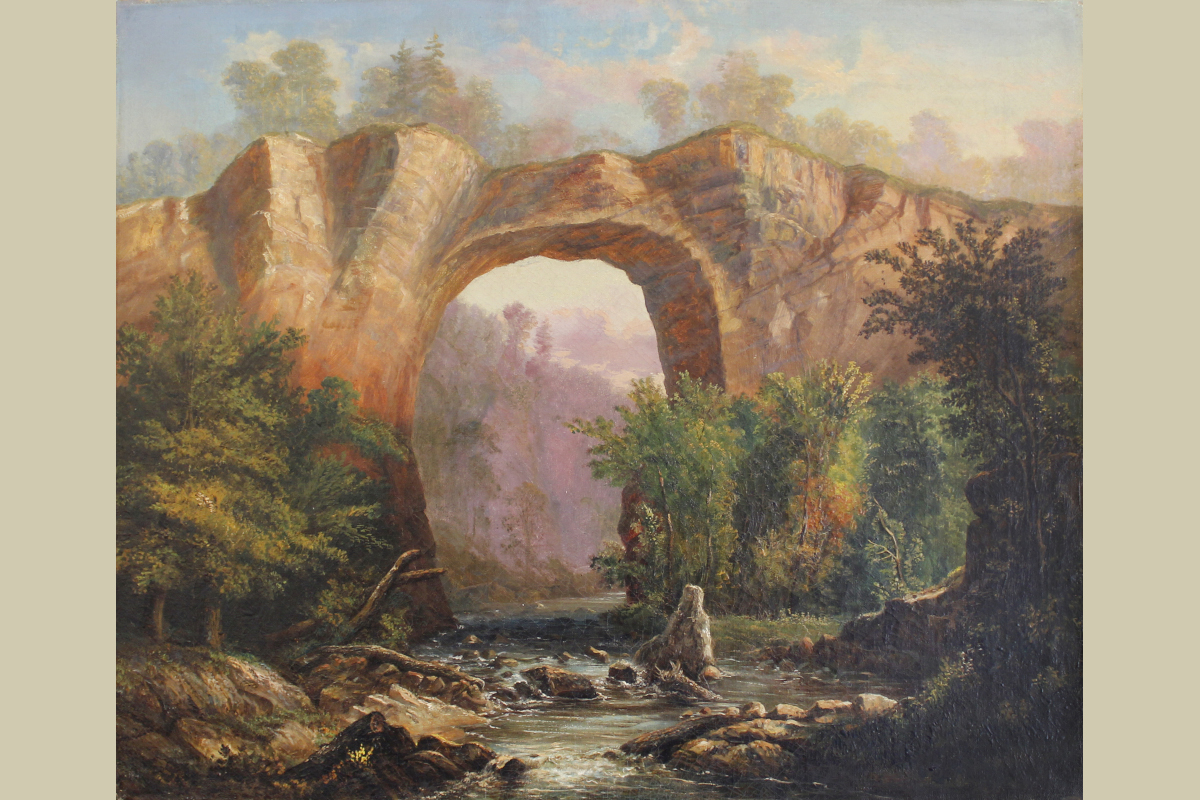
Highlights from the Collection: Untitled (Natural Bridge)
February 20 - November 8
William T. and Harriet Butterworth (Class of 1951) Miller Gallery
20 February–8 November 2026
William Thompson Russell Smith came to the United States from Scotland as a boy, settling in Pittsburgh, Pennsylvania, with his family. He studied art under James Reid Lambdin (American, 1807–1889), who had been a pupil of Thomas Sully (English-American, 1783–1872). In 1835, Smith moved to Philadelphia, where he wrote poetry and painted theatrical scenery. Inspired by the works of the Hudson River School, he traveled throughout Pennsylvania, Virginia, and New England to make sketches directly from nature. Smith began exhibiting his landscapes at the Pennsylvania Academy of Fine Arts in 1934 and became well known for his monumental views of nature.
In the late 1830s and through the 1840s, he summered and sketched in Virginia near Charlottesville and worked with geologist William Barton Rogers (American, 1804–1882). Rogers was a professor at the University of William and Mary (1828–1835), the University of Virginia (1835–1853), and later founded the Massachusetts Institute of Technology. He was the first state geologist, conducted the first geological survey of Virginia, and wrote the Geological History of the Appalachian Chain (1835), in which he discussed the action of water on various minerals and rocks. Natural Bridge in Rockbridge County, Virginia, is a 215-foot limestone arch formed by the flow of Cedar Creek, a branch of the James River, in the Ordovician Era, 500 million years ago. Smith recorded this view of Natural Bridge while working with Rogers and created this painting sometime in 1844 based on his sketches.
Smith was likely known to Rogers through Rogers’ brothers, scientists working in Philadelphia and throughout Pennsylvania on a similar geological survey of that state. Rogers’ brothers also assisted him in his work and were part of the broader national scientific and philosophical movement to study, document, and celebrate the natural beauty of the United States. The movement was part of the views championed by Virginian and third President of the United States Thomas Jefferson (1743–1826), who developed the Expansionist Movement and the concept of Manifest Destiny. For Jefferson and others of the period, collective national identity was inseparable from the natural world.
Although Natural Bridge was a sacred site for the Indigenous Monacan people, Thomas Jefferson purchased it, along with 157 acres, from King George III for 20 shillings in 1774. Believing it to be as significant as Niagara Falls in New York, he urged artistic depictions of the Natural Bridge, which he described as the “most sublime of nature’s works.” The location became a popular tourist destination and reached its peak fame in the mid 1800s. In 2016, the Commonwealth of Virginia made it a state park.
SOURCES
Barton, Emma Savage, ed. with the assistance of William T. Sedgwick. Life and Letters of William Barton Rogers. Vol. 1. Boston and New York: Houghton, Mifflin and Company,1896.
Mount Vernon Ladies’ Association. “William Thompson Russell Smith.” Museum of George Washington’s Mount Vernon. Accessed February 10, 2026. https://emuseum.mountvernon.org/people/2236/william-thompson-russell-smith.
Oliver, Christopher. Virginia Arcadia: The Natural Bridge in American Art. Richmond, VA: Virginia Museum of Fine Arts, 2001.
Pictured: William Thompson Russell Smith (Scottish-American, 1812–1896), Untitled (Natural Bridge), c. 1844. Oil on canvas. Collection of the Longwood Center for Visual Arts, American Art Collection, Gift of Arthur J. Phelan, Jr., 1979.02.